
When it comes to rifles, whether for targets or hunting, there a few things that are “must-haves”. Proper function is top of list. In that category, accuracy is number one. In the accuracy sub-category, there are a number details that really matter. Perhaps the most important detail is the trigger which must be crisp and light enough, with little to no creep. The importance of the trigger is followed closely by the barrel. While it’s probably rare nowadays to find a factory gun with a really bad barrel, it is actually quite common to find a rifle with a barrel with a less than ideal length, weight or rifling twist rate. Many are built with twist rates that are too slow. It was probably a move that manufacturers made many decades ago when bullet construction was more primitive than today’s offerings. Rifling with a twist rate that was too fast, could, in the old days actually “spin” a bullet apart. The tendency became building barrels with slower twist rates. Slow twist rates often under performed, especially as bullet designs improved, and bullet weights increased for a given caliber. Another important “function” consideration is the rifle’s stock. Wood looks nice but it can be heavy and everyone knows of it’s tendency to warp and move with changing moisture, temperature and humidity. Plastic stocks aim to eliminate those problems, which will impact accuracy and point of impact, but most factory fitted plastic stocks are heavy, not very nice looking to my discerning eye, and are often not engineered well enough to provide real consistency in accuracy. All of the aforementioned considerations can be easily remedied by purchasing an expensive custom rifle but those are costly and generally take a long time to get.
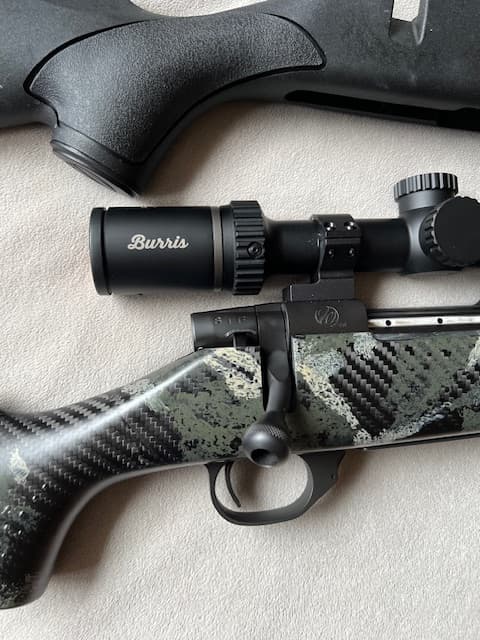
To the point of this project…. Finding an adequate factory rifle and making minor but significant upgrades to improve its functionality as a hunting gun….without breaking the bank. With the goals set, it made sense to first find an affordable factory gun that met the criteria for the project. Generally speaking the criteria was to find a light-ish bolt gun in .350 Legend for Midwest deer hunting to use in the typical mix of woodlots and smaller farm plots. I looked at most of the “cheap” factory guns, and there a lot of choices, but ultimately, I settled on a Weatherby Vanguard. I have some experience with and am impressed by Howa rifles, which are very well made for their price point. I first looked at Howa but their light weight bolt guns in .350 L all had short barrels, 16” barrels to be exact. Too short for my projects, even though I wanted something that would work equally well in a box blind, a tree stand or as light “Stalking” rifle. Howa and Weatherby have had a relationship since the 1970s, Howa being the Japanese manufacturer that makes most of Weatherby’s lower to mid-priced guns. Like Howa the Weatherby branded guns are well known for their quality and do come with the Weatherby accuracy guarantee. I found a very affordable Weatherby Vanguard in .350Legend, with a 20” sporter contour barrel, with the right twist rate. Exactly what I was looking for. A bit of extra length to optimize velocity and accuracy, without being too heavy or too clumsy in tight spaces.
Weatherby/Howa bolt guns come from the factory with a 3 position safety, a sturdy and smooth bolt and a pretty decent two-stage trigger, called the H.A.C.T. trigger, that is adjustable. While not generally a fan of two-stage triggers, theirs is very good and the first “stage” is very light and allows one to almost imperceptibly arrive at the second stage where there is a very clean crisp break of the trigger. Mine broke at 2.75 lbs. from the factory, and I didn’t feel that any adjustments were necessary.
I really didn’t need to do anything to the rifle to make it a great hunting gun. As plastic stocks go, it arrived with a really good one, with a great recoil pad. There was plenty of “free-float” around the barrel and the looks and ergonomics are fine. The Weatherby is a better set-up than the Howas in that it has real “bottom metal” and aluminum pillars, where the Howa has a plastic trigger guard to screw the action screws into. Not ideal. I contemplated leaving well enough alone with the factory stock……but I just can’t help myself.
My goal from the outset was to end up with a Mid-west woodlot version of a “mountain rifle”. That is to say, I wanted something light weight, durable and weather-proof. After a small amount of contemplation and teeth gnashing, I decided on a carbon fiber stock. I was fortunate to discover that a fantastic, “drop-in” carbon stock was available from “Stocky’s Stocks”, (Stockysstocks.com). Stocky’s has a huge selection of aftermarket stocks to fit just about any rifle that you can think of. Along with popular brand names like H-S Precision, Stocky’s has their own line of high quality fiberglass and carbon fiber stocks. Many with aluminum pillars or bedding blocks. There is wide range of stock types too. Everything from hunting to adjustable tactical to match grade target stocks are available. I’ve used a few stocks sourced from Stocky’s over the years and have had nothing but great results. They also sell match grade barrels and an assortment of accessories. Based in West Palm Beach FL., they can be reached at 561-584-8500 by phone.
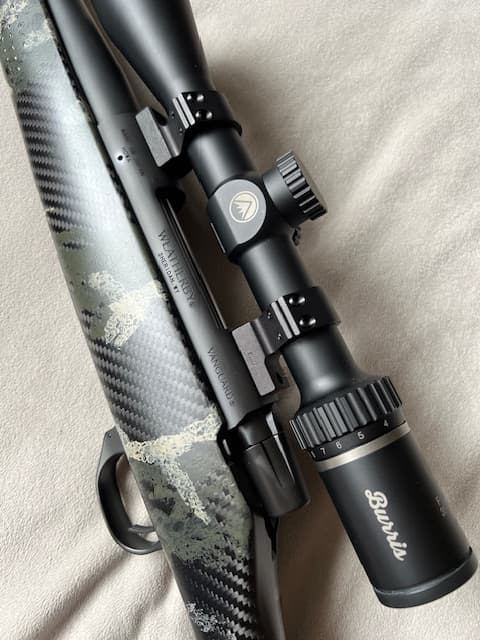
I picked the lightest, trimmest carbon stock that was available for the Weatherby/Howa platform. I picked a version with tan and olive camo on top of mostly visible Carbon Fiber weave. The traditionally styled sporter stock included standard sling studs and very nice, soft butt pad. Various barrel channels can be ordered with most of Stocky’s stocks, to accommodate whatever barrel contour your rifle sports. Even though my rifle has a slim-ish sporter barrel, I opted for a stock that would accommodate a heavy “bull” barrel, or a large diameter carbon barrel. Aside from allowing for future considerations, should I ever want to swap out barrels, I figured that a larger barrel channel would be lighter, due to less material, and would have extra “free-float” space to help with cooling and to eliminate any chance of the stock contacting the barrel, which can throw off your point of impact. The later consideration not being a real concern due to the extreme rigidity and imperviousness of the carbon fiber. These stocks are stiff and immovable! The over-all rigidity of the carbon fiber with its own built-in aluminum pillars should be an improvement over the factory stock to keep things locked in place. The upgrade carved 1.3 lbs. off the rifle bringing it to a bit under 5 lbs. without scope. A huge improvement!
With a very nice lightweight deer rifle in hand it was time for a scope. In keeping with the light weight, inexpensive but very capable theme, I poured over the possibilities. I have a lot of experience with scopes and have zero tolerance for poor performance. There are brands that I won’t even consider anymore, and brands that I have the utmost confidence in choosing.
One of the first scopes I ever bought was a Burris Fullfield II back in the 80s, to mount on my first bolt gun, a sporterized Winchester 1917 WW1 surplus gun in .30-06 It was a beautiful tank of a gun with an Mauser action that was like butter, in a slim walnut Bishop stock. I used it for a few deer seasons with the peep sights that it came with. It was dead accurate out to 100 yards, about my limit with the irons sights, but I wanted to reach the far side of the corn fields that I frequented in Northern Michigan. The addition of that Burris scope was an epiphany. The combination of clear crisp glass and the relatively fast twist of that surplus rifle made for a tack driver. I used that gun/scope combo for many years, in often harsh conditions and situations. Neither ever let me down. While I have also used many other scope brands over the years, some of which I have equal faith in, I’ve always considered Burris to be fantastic value. Durable, reliable, stylish, clear, consistent and available with whatever features suit the need.
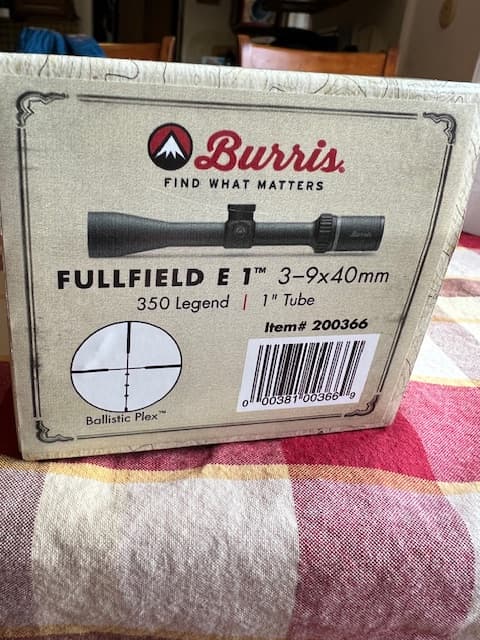
For my “budget” “Midwest mountain rifle” (as I’ve come to call it), I decided on what has turned out to be an incredible value. At well under $200 the Burris Fullfield E1 3x9x40, with the ballistic plex, calibrated to the .350 Legend round, would be a bargain at 3 times the price. (Burrisoptics.com) Great looking, with a matt black finish, crystal clear coated glass, large tactile adjustment knobs and covers and very rugged construction over all, it really fits the bill. The Burris “No questions asked” “Forever Warranty” made it a no-brainer for this build.
Set in lightweight Tally base/ring combos and adjusted for eye relief, level and bore alignment it was time for a sight-in. Sitting just ¼” off the top of the barrel, in the Talley rings, the Burris aligned perfectly with my eye with a comfortable cheek weld, and made for a neat, trim package. After a few shots at 25 yds to ensure I was “on-paper” and zeroed, I moved out to 100 yds., made a few more minor adjustments and proceeded to marvel at the clarity of the optics and the accuracy and consistency of the shooting experience. The optics combined with the low recoil allowed me to see my impacts on target. After zeroing, I intentionally spun the dials 10 clicks each, then back to my “zero” point, looking for any variation in point of impact. There was none. Moving out to 200 yds. I used the pre-calibrated “hold-over” marks, designated for that yardage with the .350 L round. Smack dab on the bullseye, with sub MOA groups, which exceed the Weatherby 1” group guarantee. My load of choice (for all .350 Legend use) is the Hornady 170 grain pointed soft point. A happy medium between 150 and 180 grain loads in terms of energy, trajectory and ballistic coefficient, it has also proven to be durable and highly effective. I have no doubt that it would work just fine for elk or even moose at moderate ranges, or for black bears, and I wouldn’t feel unsafe with the 170 grain Hornady round in .350, as grizzly bear protection, though for that specific use I might prefer an AR platform…
Some guns are a joy to carry. It’s what usually matters as much as anything else when picking a gun from the rack. This build, as intended, is light, fast pointing, accurate, is just good looking and it’s a joy to carry and shoot. There’s no doubt that when packing for a Midwest deer hunt, it’ll be my first pick.
So, can a “cheap” factory rifle with a “cheap” scope be turned into a highly capable, accurate, lightweight, weatherproof, compact hunting rifle, legal for deer anywhere in the USA? You bet. With a total cost, and effort to acquire, far lower than a custom gun, and with all the benefits of a custom gun, it’s a win-win situation. If you can’t find exactly what you’re looking for in a hunting rifle, consider easy, DIY upgrades. You just might end up with a gem. I did.
Brandon Vaughan has over 40 years of personal and professional experience in a broad array of hunting and fishing disciplines, from Alaska to Belize. Past professional experience includes working as a professional guide in Alaska and around the Great Lakes region. In addition to hunting and fishing throughout the lower 48, Canada and Central America, Brandon has been an Orvis Endorsed Fly-fishing guide, a fly-fishing and fly-tying instructor, a hunting guide and shooting instructor.